When Light Takes Root An urgent mission
Plastic waste in the oceans is one of the biggest environmental crises of our time. Every year, millions of tons of plastic end up in the world's oceans. The waste collects to form huge islands in the open sea, washes up on beaches and slowly decomposes - with devastating consequences for animals, plants, entire ecosystems and ultimately for us humans too.
The tiny particles that are created during decomposition - known as microplastics - end up in the food chain because marine animals mistake them for food. This often leads to digestive problems, poisoning or even death of the animals.
When seafood is consumed, the tiny particles can enter the human organism and be deposited in various organs. Scientists suspect that microplastics can trigger inflammation or toxic reactions in the body.

-
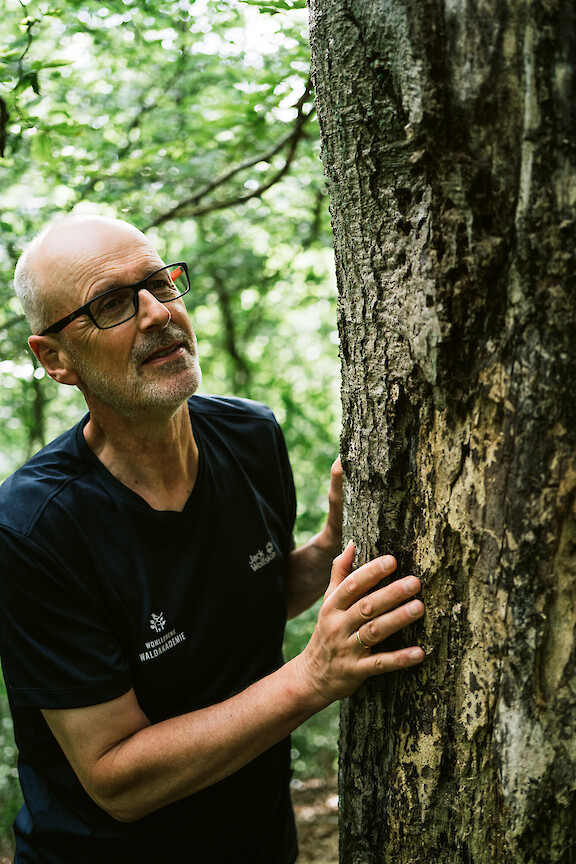
“For a long time, we thought that species competed with one another. Everyone against everyone. But that isn’t true. They are cooperative ecosystems. And the same should apply to us humans.”
Peter Wohlleben
The forester and bestselling author on energy efficiency, biorhythms and the natural intelligence of trees.
When Peter Wohlleben talks about the forest, nature comes alive – full of relationships, exchange and balance. In conversation with Lightnet Journal, the forester explains what companies and designers can learn from ecosystems: cooperation instead of competition, intelligent use of energy and a harmonious interplay between light and life.
Energy efficiency – nature’s economy of light
Lightnet Journal: “The forest operates with remarkable efficiency: not a single ray of light is wasted, and every leaf makes optimal use of the available spectrum. As a lighting manufacturer, what can we learn from this economy of light in nature?”
Peter Wohlleben: “Nature tries to convert as little energy as possible into heat,” Wohlleben explains. “This is something we have only gradually come to understand in technology. In the past, incandescent bulbs produced more heat than light – nature has been doing it better for 4.2 billion years. Fireflies, for example, produce light with almost no heat loss. Trees also store energy efficiently – they do not radiate heat but operate with minimal energy input. This ensures stability in ecosystems. We humans could learn a great deal from this.”
Biophilic design: How nature heals spaces
Lightnet Journal: “In architecture and design, we often talk about biophilic design – in other words, the connection between nature and the built environment. From your perspective, how can nature really be made ‘tangible’ in interior spaces?”
Peter Wohlleben: “The idea of bringing nature into
-
Peter Wohlleben
“Fireflies are true masters of efficiency and have been producing light with almost no heat loss for thousands of years.”

Do plants like being stroked?
Peter Wohlleben: “Many people stroke their plants – and they’re right to do so, because it really does help. Plants grow more robustly as a result. They don’t interpret touch as affection, but as a mechanical stimulus – similar to what happens in nature when an animal brushes past. They respond by growing more compactly and becoming more resilient. It’s a fascinating example of just how sensitively plants respond to their environment.”
How are the world’s forests doing?
Peter Wohlleben: “The more natural a forest is, the better it is doing. Unfortunately, many plantations are now described as forests. These are vulnerable to heat, drought and extreme weather. We see this equally in Germany, Canada, Australia and the Amazon. Intact natural forests, by contrast, are remarkably resilient. In Chernobyl, for example, a diverse wilderness has re-established itself across more than 2,000 square kilometres – evidence of nature’s enormous capacity for recovery.
Forests need cool, moist conditions, wherever they are in the world. If we give them more space, they can regenerate. International agreements such as the Montreal Protocol or the EU Nature Restoration Regulation show that this has been recognised. Even in China, a great deal is now being done to protect forests. The situation is critical, but it is not yet lost. The world has recognised this – now we need to act.”
Text: Mathias Siebel
Photography: Wohllebens Waldakademie

A Piece of Ancient Forest for Tomorrow
How Lightnet, together with Wohllebens Waldakademie, is protecting an area of forest in “Wildnisjuwel Lohmar” for at least fifty years.
