When Light Takes Root
At Lightnet, sustainability is not meant to remain a concept. It should become something people can experience. That is why the company supports a forest conservation project initiated by Wohlleben’s Forest Academy, protecting 643 square meters of near-natural woodland from forestry use for at least fifty years. No forestry. No intervention. Just time, tranquility, and regeneration.
Lightnet invited its employees to experience this idea for themselves. After an inspiring talk by Peter, they headed into the forest. Among moss, ferns, and centuries-old beech trees. Away from technical lumen values and color rendering indices, toward the subtle gradations of natural light filtering through clouds and the forest canopy. Light that nobody has planned. That changes when a branch moves. That has a scent when the forest floor is wet.
It offers a different perspective. And a necessary one. In the interview with the bestselling author that followed, this impression was distilled into a single sentence: “Fireflies are true masters of efficiency and have been producing light with virtually no heat loss for thousands of years.” As a luminaire manufacturer, a statement like that is enough to make you feel briefly humbled. Nature solves problems that engineers spend decades working on: quietly, elegantly, and without waste.
Wohlleben is interested in this interplay. “For a long time, we thought that species competed. Everyone against everyone else. But that isn’t true. They are cooperative ecosystems. And the same should apply to us as human beings. Where social cohesion and the willingness to cooperate are lacking, societies fall apart.”
This idea inspires Lightnet. It can be found in products that learn from organic forms and the behavior of natural light – such as Liquid Line, which has grown into a tree of light at Lightnet’s headquarters in Cologne. Not a symbol. An attitude. The partnership with the Forest Academy is only the beginning. From October 1 to December 31, 2026, for every meter of Liquid Line ordered, Lightnet and Wohlleben’s Forest Academy will protect a further square meter of natural forest for 50 years. In this way, customers become active participants in the project.
Wohlleben is pleased. Because nature, he says, is fundamentally a cooperative system.
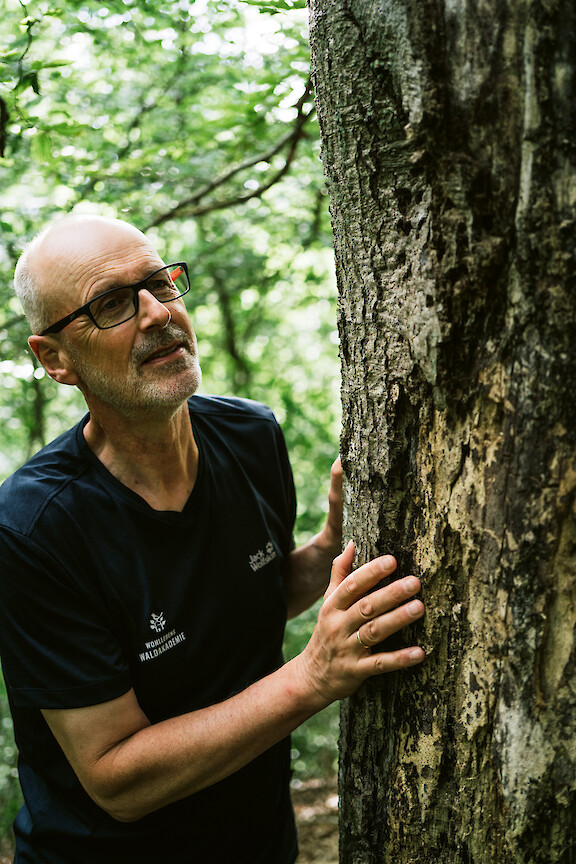

-
“For a long time, we thought that species competed with one another. Everyone against everyone. But that isn’t true. They are cooperative ecosystems. And the same should apply to us humans.”
Peter Wohlleben
The forester and bestselling author on energy efficiency, biorhythms and the natural intelligence of trees.
When Peter Wohlleben talks about the forest, nature comes alive – full of relationships, exchange, and balance. In conversation with Lightnet Journal, the forester explains what companies and designers can learn from ecosystems: cooperation instead of competition, intelligent use of energy, and a harmonious interplay between light and life.
Energy efficiency – nature’s economy of light
Lightnet Journal: “The forest operates with remarkable efficiency: no ray of light is wasted, and every leaf makes optimal use of the available spectrum. As a luminaire manufacturer, what can we learn from nature’s economy of light?”
Peter Wohlleben: “Nature tries to convert as little energy as possible into heat,” Wohlleben explains. “This is something we have only gradually come to understand in technology. In the past, incandescent bulbs produced more heat than light – nature has been doing it better for 4.2 billion years. Fireflies, for example, produce light with virtually no heat loss. Trees also store energy efficiently – they do not radiate heat, but operate with minimal energy input. This helps maintain stability in ecosystems. We humans could learn a great deal from that.”
Biophilic Design: How nature can heal spaces
“In architecture and design, we often talk about biophilic design – the connection between nature and the built environment. From your perspective, how can we make nature truly ‘tangible’ in interior spaces?”
“The idea of bringing nature into interior spaces is scientifically supported. The color green alone increases pain tolerance and has a calming effect. Real plants enhance this effect because our bodies have evolved to respond to natural ecosystems. Even birdsong has an antidepressant effect – including recordings. There is just one thing I would avoid: moss walls. Many of them originate from illegal harvesting in the wild. Artificial plants or sustainable natural materials such as wood, combined with plants and the right lighting, are a better choice.”
Do plants need darkness?
“Trees beneath streetlights are unable to break down free radicals at night. They do not sleep properly, their leaves become thicker, and the trees have shorter lifespans. Outdoor lighting should therefore be switched off after a certain time – it disrupts plants and animals that orient themselves by moonlight,” Wohlleben explains.
The example shows just how strongly artificial light can influence biological processes – and not only in plants. “Our biorhythm is attuned to changes in light throughout the day. If we take this into account in lighting systems, we can support health and well-being.”
Peter Wohlleben

Do plants like being stroked?
Peter Wohlleben: “Many people stroke their plants – and they’re right to do so, because it really does help. Plants grow more robustly as a result. They don’t interpret touch as affection, but as a mechanical stimulus – similar to what happens in nature when an animal brushes past. They respond by growing more compactly and becoming more resilient. It’s a fascinating example of just how sensitively plants respond to their environment.”
How are the world’s forests doing?
Peter Wohlleben: “The more natural a forest is, the better it is doing. Unfortunately, many plantations are now described as forests. These are vulnerable to heat, drought and extreme weather. We see this equally in Germany, Canada, Australia and the Amazon. Intact natural forests, by contrast, are remarkably resilient. In Chernobyl, for example, a diverse wilderness has re-established itself across more than 2,000 square kilometers – evidence of nature’s enormous capacity for recovery.
Forests need cool, moist conditions, wherever they are in the world. If we give them more space, they can regenerate. International agreements such as the Montreal Protocol or the EU Nature Restoration Regulation show that this has been recognized. Even in China, a great deal is now being done to protect forests. The situation is critical, but it is not yet lost. The world has recognized this – now we need to act.”
Text: Mathias Siebel
Photography: Wohllebens Waldakademie

A Piece of Old-Growth Forest for Tomorrow
How Lightnet, together with Wohllebens Waldakademie, is protecting an area of forest in “Wildnisjuwel Lohmar” for at least fifty years.

Light Is Growth Design
A line of light becomes a tree. A story that begins in a space and leads back to the forest.