When Light Made Us Wonder
How a visit to a small industrial town in Westphalia sparked the idea for one of the most exciting artworks ever shown at a lighting trade fair.
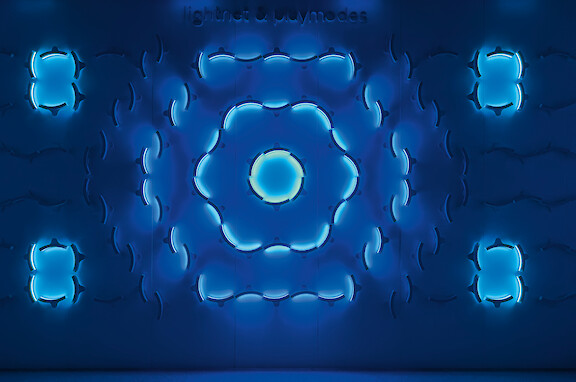
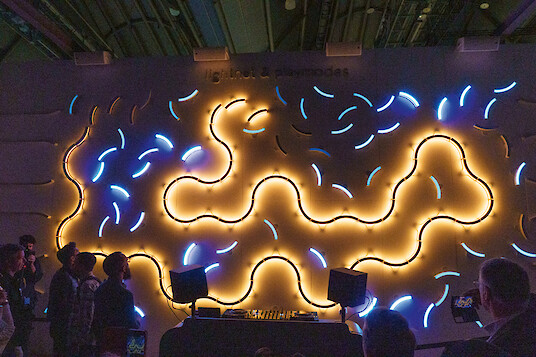
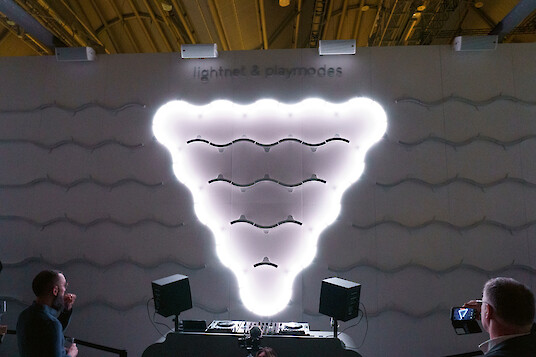
Liquid Tiles takes the form of a two-dimensional canvas: a modular wall on which a series of 60° arcs are arranged in a triangular matrix.
There are moments you simply cannot plan. In more than twenty years of company history, Lightnet has seen more light than most people would encounter in several lifetimes. You see systems, decisions, compromises. As a lighting manufacturer with more than 600 employees across seven locations worldwide, light is our daily craft, our language, our profession.
And then Lightnet’s founder found himself in Unna.
The Centre for International Light Art in this small Westphalian town is not somewhere you simply stumble into. You go there because you are looking for something. What he found that evening was not what he had been looking for. The Catalan artist duo Playmodes were exhibiting Signes: a kinetic light installation in which algorithms and motors speak a language together that is neither writing nor music – and yet somehow both at once.
He was rarely amazed. That evening, he was.
Not the polite nod of the connoisseur, but genuine wonder – the kind that leaves you speechless for a moment. On the way home, a small, persistent question began to take hold.
What if…?

-
Who is Playmodes?
Eloi Maduell and Santi Vilanova have been working from their studio in Barcelona since 2006 – and “atelier” describes it better than “office”. This is a place where soldering and programming happen side by side, where algorithms are written like scores and lighting elements are tuned like instruments. Maduell comes from an engineering background, Vilanova from graphic design and sound studies. What brings them together is something they call Visual Music: the belief that light and sound are fundamentally the same thing – vibration. They develop their own tools. They write their own software.
The answer to that question wasn’t long in coming. But before it reached the world’s largest lighting trade fair in Frankfurt, it would take a long detour via 126 motors, an industrial hall in Poland and a formula from the 18th century.

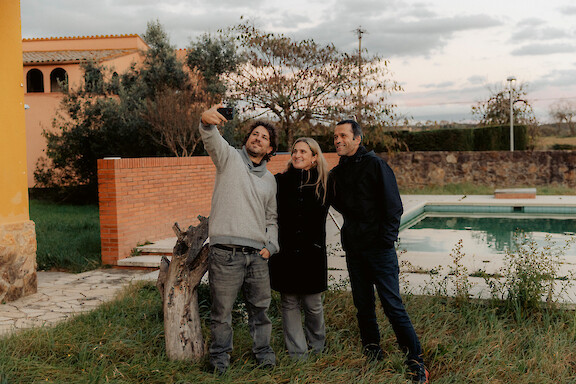
One call, two worlds.
And how Lightnet handed Playmodes the key to the work.
Petra Siebel is responsible for marketing at Lightnet. Sometimes, that means bringing the right people together. She made contact with Playmodes and arranged a video call. What happened next can be summed up in one sentence: it was a perfect match.
Instead of negotiating, they shared visions. Lightnet brought more than twenty years of experience in development, production and lighting architecture. Eloi Maduell and Santi Vilanova brought two decades of working at the boundaries of art, science and technology – along with a deep conviction that light and sound are fundamentally the same thing. The mutual respect was immediate. A genuine appreciation of what the other had achieved over the years. The foundation for everything that followed.
The roles were quickly defined. Lightnet would take care of all the hardware: development, engineering and production at its own facility in Poland. Playmodes would take on the artistic direction, the concept and the programming. Full access to all luminaire families. Engineers as sparring partners. And one shared goal that was both a promise and a source of pressure: Light + Building in Frankfurt in March 2026.
Behind the Scenes of Liquid Tiles
People, tools, first movements: a brief look at the making of a wall that would soon come to life.
-
Playmodes
“When we visited the Lightnet factory and they showed us everything, we felt like Charlie in Willy Wonka’s chocolate factory.”
The First Idea – and Its Limits
The first concept was bold. Using Lightnet’s Matric luminaire family, basic geometric forms – circles, triangles and squares – were to create a three-dimensional space of light and movement. The excitement of those first weeks was considerable. Then reality began to impose its limits on the idea. Messe Frankfurt’s safety regulations are exactly what they need to be: strict.
Approval was not going to happen. Time was running out. Ideas went back and forth, concepts were developed further, alternatives were discarded. Eventually, a great deal of work had gone into the project – and yet they were back where they had started.
The trade fair was getting closer.
Of a failed plan, a bold change of direction – and why a pattern from 1704 became the key to one of the most exciting light installations of our time.

It was time to change course. Lightnet brought another luminaire family into play: Liquid Line – at the heart of the company’s design philosophy. Freely configurable light modules in organic curves that can be assembled into flowing lines of light and sculptural forms. Fluid, organic, precise. The documents were sent to Barcelona.
The answer came quickly. And it came with an exclamation mark. The Truchet principle!
Maduell and Vilanova immediately recognised the potential in the proposal. Liquid Line can be bent in every dimension – including into a 60-degree curved segment. And 60-degree segments arranged in a modular pattern: that is Truchet tessellation.
Sébastien Truchet was a French Dominican friar and mathematician who, in 1704, described what happens when simple tiles are arranged in different orientations: an infinite variety of patterns generated from remarkably simple rules. Local decisions create global structures. In 1987, historian of science Cyril Stanley Smith summed it up like this: “Hardly anywhere do the paths of the artist and the scientist intersect as closely as in the creation of tile patterns.”
For Playmodes, this wasn’t abstract mathematics. It was an invitation. What followed was an intensive, iterative collaboration. Playmodes developed algorithms that defined how the 126 lighting elements would interact with one another: movements, colour values, sequences and sounds. Lightnet’s engineers translated these specifications into hardware – motors, controls and mechanisms that brought what existed on screen into the physical world.
Six behaviours emerged. Playmodes named them as musicians might name their pieces: Fuller, Spaghetti, Feather, Snake, Kaleidoscope, Duality. Each behaviour has its own choreography, its own character – all created from the same 126 modules, the same rules. Simple. Alive.
The Wall Comes to Life
Poland, February 2026. Frankfurt, March 2026.
126 motors, an industrial hall, a quiet moment before it all began.
Four weeks before the trade fair, somewhere in Poland. An industrial hall with ten-metre-high ceilings, early February. Fire burning in barrels. A tarpaulin covering the assembled artwork to keep the technology from freezing. Maduell and Vilanova at their laptops. Lightnet’s Research and Development team, lighting designer Stefan Hofmann, Petra Siebel – all standing together in front of Liquid Tiles for the first time. And then: the first sequence.
Playmodes are the most critical observers in the room. They see what isn’t quite right yet, where the transitions still stumble. But even they cannot stop a smile from spreading across their faces. The artwork is alive. Glasses are raised, then everyone returns to their computers late into the night. There is still plenty to do before the trade fair. But everyone knows: something unique is taking shape.
Frankfurt, March 2026. Light + Building, Hall 3.1, Lightnet’s stand. The familiar trade fair chaos that, shortly before the doors open, somehow transforms into orderly structures. On one wall of the Lightnet space, something different is taking shape.
The 126 modules hang row by row, segment by segment. Lightnet engineers Kamil and Damian check the connections. Across from them, Maduell and Vilanova finalise the programming. The Lightnet team arrives at the stand and gathers in front of the wall: the structure works. It quickly becomes clear – this is going to attract attention. Exhibition stand builders from neighbouring stands stop to look. Not a profession that is easily impressed. Smartphones come out. Then they move on. Not a bad first audience.
That evening, everyone involved gathers together – the team from Poland, Playmodes from Barcelona, colleagues from Cologne and from all the other Lightnet locations around the world. They thank one another for the work, the openness and the willingness to put art before convenience. Then Playmodes takes over. Liquid Tiles comes to life.
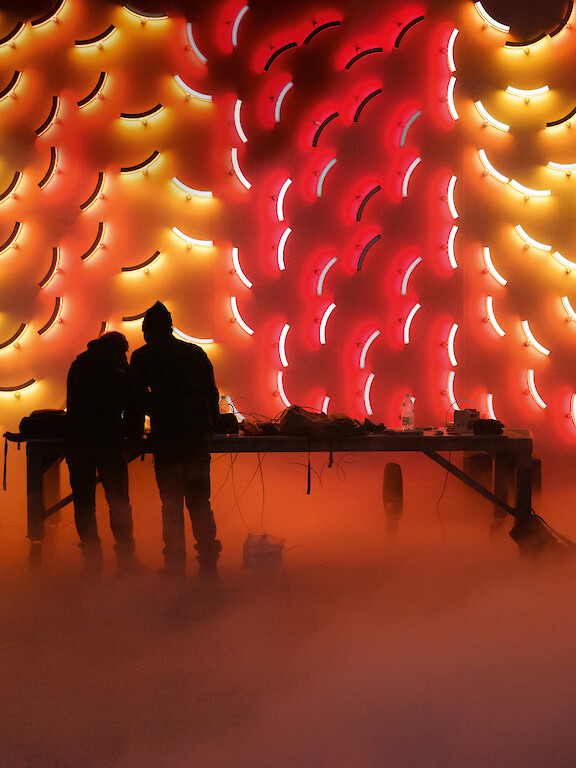
126 segments rotate, each according to its own rule, all following an overarching logic. Light flows across the wall like water. Forms emerge and disappear. Warm orange dissolves into cool blue. “We feel that light and sound are fundamentally the same thing,” Santi Vilanova once said. “It’s about vibration.” Here, that isn’t philosophy. It is reality.
The Light + Building audience was amazed. First hundreds, then thousands. Architects, lighting designers and designers from 170 countries saw what happens when industry and art think together. Several videos went viral – until millions of people had seen a wall come to life.
A magical moment for Playmodes and the Lightnet team: during the dress rehearsal, Liquid Tiles comes to life for the first time.
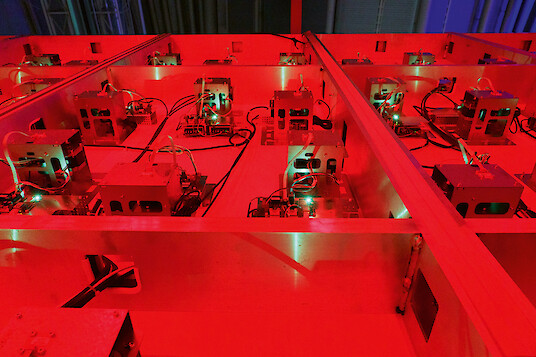
All control electronics and PCB production were carried out in-house at Lightnet’s own facility.
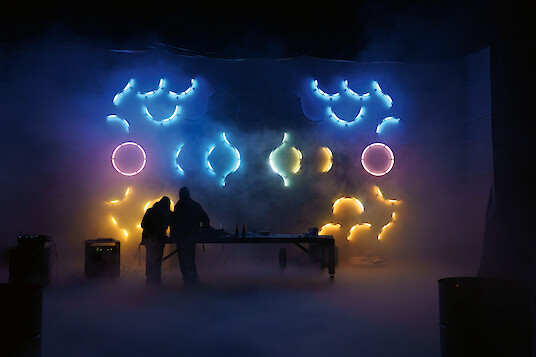
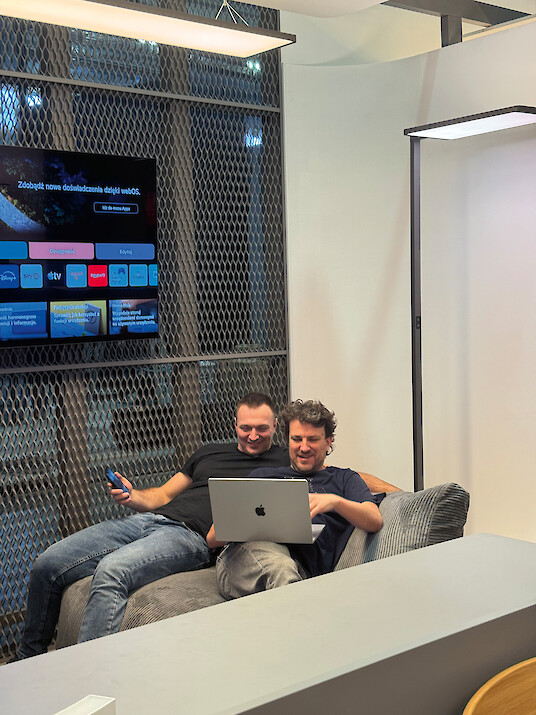
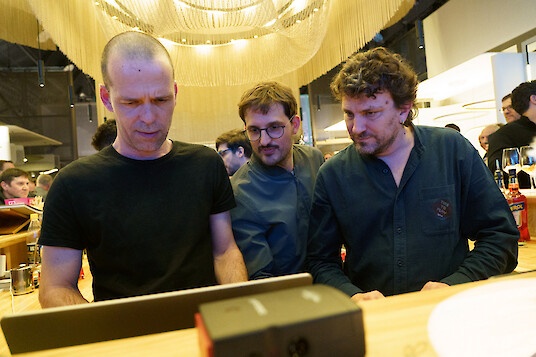
Kamil from Lightnet (left) and Santi from Playmodes fine-tuning Liquid Tiles together.

A shared project became something more: Playmodes and Lightnet celebrate Liquid Tiles and the friendships that grew along the way.
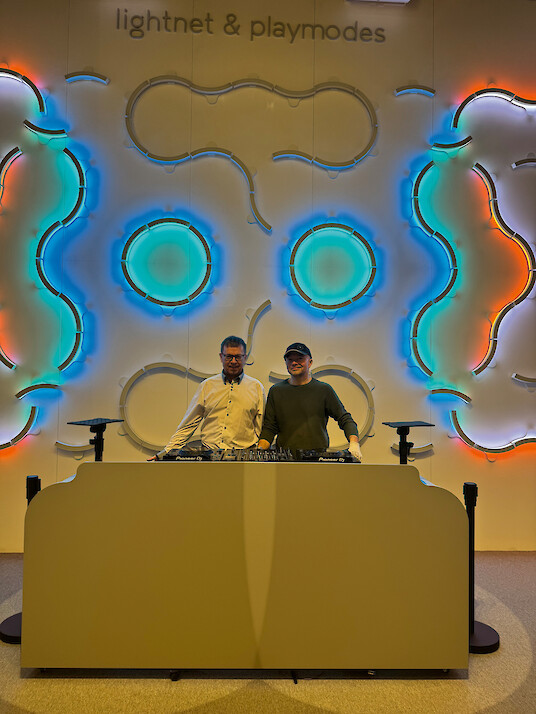
When everything is running smoothly behind the scenes at Light + Building, Marek (left) and Christoph are usually not far away.
Text: Mathias Siebel
Photography: Kayla Kauffman & Felix von der Osten

Light Is Growth Design
In Liquid Tiles, Liquid Line forms a moving matrix. In Formo’s Frankfurt office, it becomes a tree of light, growing from floor to ceiling. In the forest, the story continues.

Compliant with Standards, Yet Still Unsafe Deep Dive
With Liquid Tiles, safety requirements brought the first design to a halt. In a school corridor, every requirement can be met and finding your way can still be difficult. Why standards are necessary, but cannot account for everything.