Seen from below
Fifteen minutes can feel like a long time when you’re waiting for test results. At reception, the same fifteen minutes fly by. Three phone calls, a prescription, a patient without an appointment. All at once, of course.
In medical practices, health centers and hospitals, these situations often unfold just a few meters apart. Each places different demands on the design of the space and its lighting.
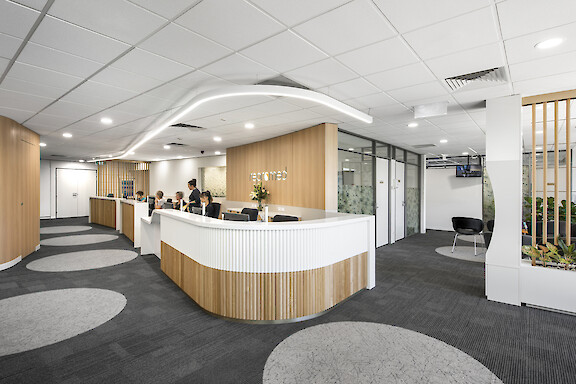

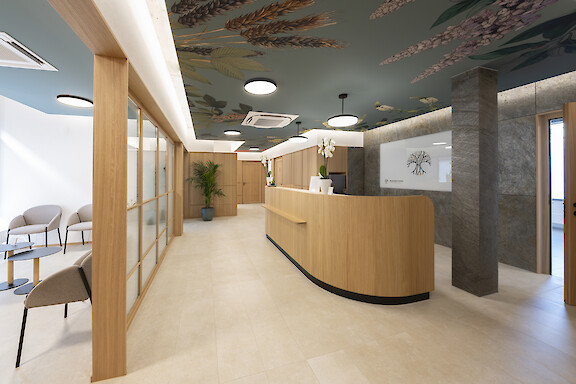 Baldi medical practice in Basel
What comes into view
At reception, attention centers on the counter and the person opposite. Someone types something in or passes over a form. Light is needed above all where the work happens: on the counter, on the page, at the screen.
In the waiting room, there is more time to look around. You glance at the door, at the clock or out of the window. You leaf through a magazine or simply sit there. Eventually, your gaze wanders toward the ceiling. Perhaps you notice a luminaire. Or perhaps it is the light it casts onto the ceiling that first catches your eye. For a moment, something usually at the edge of your attention becomes interesting.
Then someone calls a name.
On the examination table, there is less choice about where to look.
One building, many perspectives
Waiting, talking, being examined or accompanying someone. What we notice about a space changes with the situation. And so does what we need from the lighting.

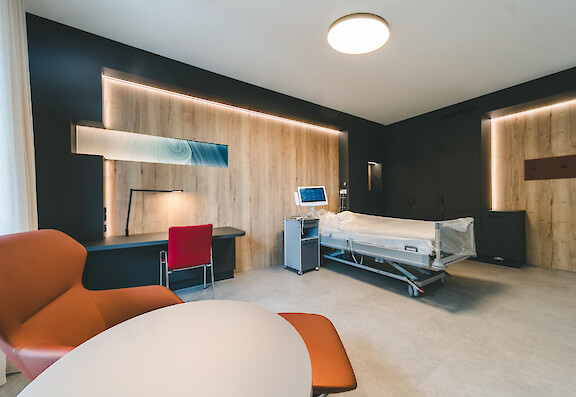 Clinic for Manual Therapy in Hamm, Photography: PBM Visuals
The underside comes into view
We usually see luminaires as we enter a room: while walking, at an angle from below, from a few meters away. On the examination table, this perspective changes. The light-emitting surface and the edge of the housing can come directly into view.
From the side, you can see how far a pendant luminaire hangs below the ceiling. From below, this distance is less apparent. Instead, the light-emitting surface and its relationship to the ceiling become more prominent. Against a dark ceiling, it can look like a bright cut-out; against an illuminated ceiling, almost like part of the ceiling itself.
Someone lying on an examination table cannot simply look around the room to turn their gaze away from the light. A luminaire may remain directly in their field of vision for an extended period.
Good lighting design therefore considers both how a space looks and how people experience it from different positions.

Sofa, rug, plant: what about the lighting? Design questions
A floor lamp beside the sofa doesn’t automatically make an office feel inviting. What matters is whether that corner becomes a place in its own right.