Sofa, Rug, Plant: And the Light?
These days, we can work almost anywhere. At the kitchen table, on the train, at home, or somewhere in between. That hasn’t made the office obsolete. Its role has simply changed.
The office has a new job. Several, in fact. It is a place to work, to meet, and to retreat. Quite a lot for a space that once mainly had to accommodate desks.
And perhaps that explains why offices look different today. Softer. Warmer. Sometimes suspiciously residential. Carpets now cover floors where office chairs once rattled across hard surfaces. Wood is hardly an unusual sight anymore. The plants were probably already there. And lighting, too, is now allowed to do more than simply illuminate desks properly. Of course, there is still a sofa somewhere.
But does a sofa really make an office feel more like home?
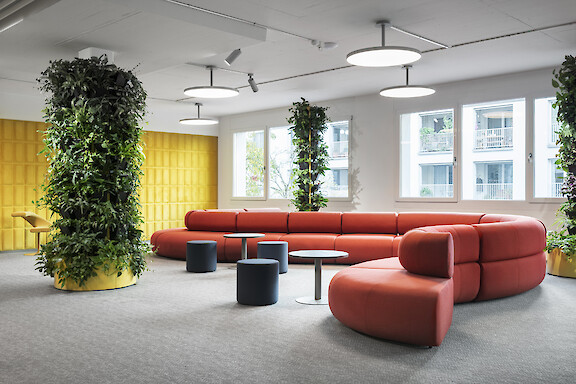
Coziness Is Not an Interior Style
Probably not. Otherwise, it would be pretty simple. Put in a sofa, add a rug underneath and a plant beside it. And there’s your new office.
But a space doesn’t automatically feel different just because the furniture list has changed. Coziness begins one level deeper.
With the question of whether you want to stay or simply get through your workday. Whether there is a place for six people to talk and another where no one can overhear.
Perhaps coziness is therefore less about what is in a space than about what the space makes possible.
A Place You Want to Come To
Some things simply work better together. Whether you enjoy coming into the office for them also depends on how the space feels.

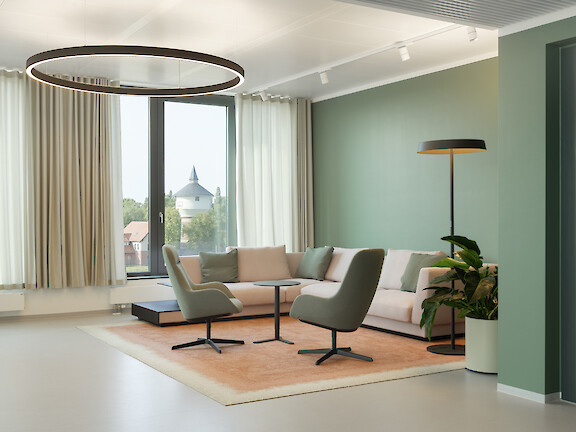
One Space Becomes Many Places
Light works in much the same way. A warmer color temperature or lower light levels alone do not make an office feel more homelike. After all, a desk does not become more homelike simply because it is less well lit.
If a large office space is lit in the same way throughout, it remains just that: one large space. Bring the light closer to a table or seating area, and a distinct place begins to emerge.
A free-standing luminaire beside the sofa becomes part of the interior as a freestanding object. A low-hanging luminaire sits closer to the table than to the ceiling. Both shape the space before they are even switched on.
Once switched on, their effect goes beyond their form. The form of a luminaire ends at its housing. Its light does not. It needs to suit what happens in that particular place. If someone suddenly opens their laptop in the seating area, the lighting cannot stop at looking good.
A free-standing luminaire beside the sofa does not make an office feel like home. What matters is whether the corner with the sofa becomes a place of its own.

Compliant with Standards, Yet Still Unsafe Deep Dive
A space can be lit in accordance with standards and still remain difficult to read. How contrast, glare, and the distribution of light determine whether orientation is intuitive.