Sofa, Rug, Plant: And the Light?
Plastic waste in the oceans is one of the biggest environmental crises of our time. Every year, millions of tons of plastic end up in the world's oceans. The waste collects to form huge islands in the open sea, washes up on beaches and slowly decomposes - with devastating consequences for animals, plants, entire ecosystems and ultimately for us humans too.
The tiny particles that are created during decomposition - known as microplastics - end up in the food chain because marine animals mistake them for food. This often leads to digestive problems, poisoning or even death of the animals.
When seafood is consumed, the tiny particles can enter the human organism and be deposited in various organs. Scientists suspect that microplastics can trigger inflammation or toxic reactions in the body.
Homeliness Is Not an Interior Style
Probably not. Otherwise, it would be pretty simple. Put in a sofa, add a rug underneath and a plant beside it. And there’s your new office.
But a space doesn’t automatically feel different just because the furniture list has changed. Homeliness begins one level deeper.
With the question of whether you want to stay or simply get through your workday. Whether there is a place for six people to talk and another where no one can overhear.
Perhaps homeliness is therefore less about what is in a space than about what the space makes possible.
A Place You Want to Come To
Some things simply work better together. Whether you enjoy coming into the office for them also depends on how the space feels.

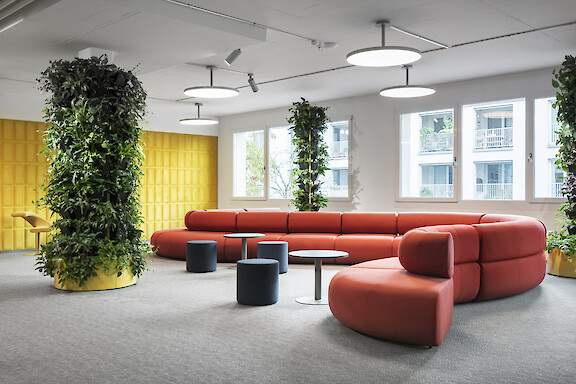
Lounge area with organically shaped seating and large circular ceiling elements with integrated lighting.
One Space Becomes Many Places
Light works in much the same way. A warmer color temperature or lower light levels alone do not make an office feel more homelike. After all, a desk does not become more homelike simply because it is less well lit.
If a large office space is lit in the same way throughout, it remains just that: one large space. Bring the light closer to a table or seating area, and a distinct place begins to emerge.
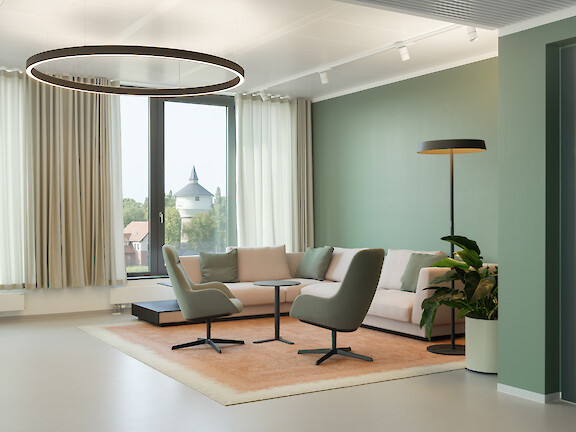
A floor lamp beside the sofa becomes part of the interior as a freestanding object. A low-hanging luminaire sits closer to the table than to the ceiling. Both shape the space before they are even switched on.
Once switched on, their effect goes beyond their form. The form of a luminaire ends at its housing. Its light does not. It needs to suit what happens in that particular place. If someone suddenly opens their laptop in the seating area, the lighting cannot stop at looking good.
A floor lamp beside the sofa does not make an office homelike. What matters is whether the corner with the sofa becomes a place of its own.

Compliant with Standards, Yet Still Unsafe
A space can be lit in accordance with standards and still remain difficult to read. How contrast, glare, and the distribution of light determine whether orientation is intuitive.