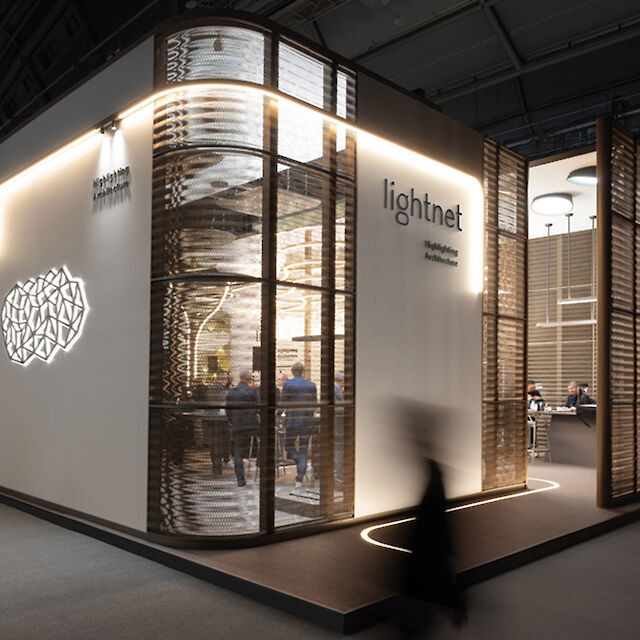
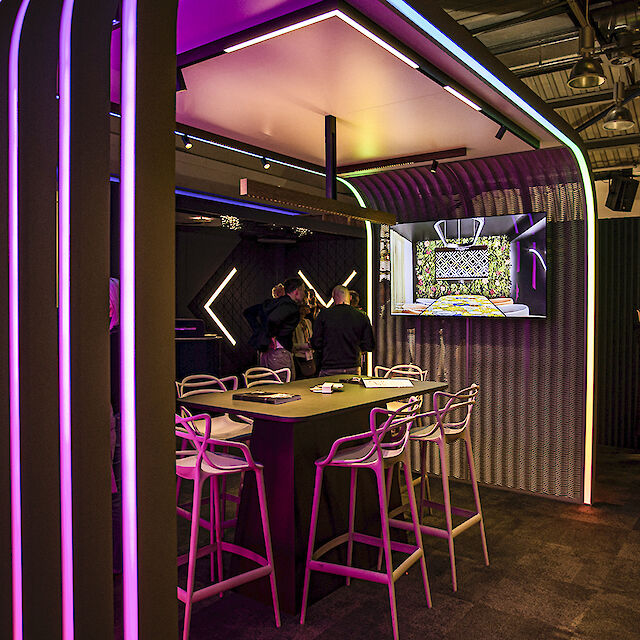
At Light + Building 2026, our exhibition stand will become an experimental space, inviting visitors to rethink light. Under the motto “Time To Play,” we will show how creative freedom, technological precision, and architectural systematics come together.
The focus will be on our collaboration with the Catalan artist collective Playmodes. The kinetic installation Liquid Tiles creates a modular, audiovisual structure consisting of 126 rotating light elements. Each segment follows a clearly defined geometry and is controlled by generative algorithms within precise parameters in terms of movement, color, and sound. The result appears organic – even though it is technically controlled with precision. The boundaries between object and process, between programmed system and living effect, begin to blur. While Playmodes developed the software, firmware, and generative logic, we designed and manufactured all hardware components in-house. The installation is thus not only a work of art, but also an industrial testing ground—a dialogue between artistic research and engineering implementation.
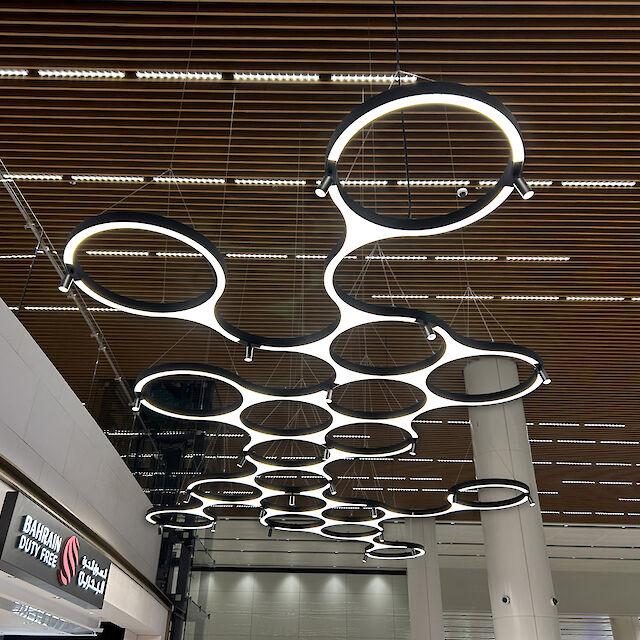
The centerpiece of the exhibition stand is the large-format light installation, which we realized together with Playmodes. It shapes the space not only visually, but also atmospherically. As a moving structure of light and form, it translates technical precision into an almost organic dynamic. In its dimension, complexity, and integrative planning, this installation is a unique project within our exhibition presence. The rest of the stand architecture also stands out confidently and complements the installation with a space-defining element. In the bar area, Liquid Line and Ringo Star merge with filigree metal chains to form a floating light architecture that balances transparency and structure. The reduced profile of the light lines meets movable metal links that do not shield the light, but make it tangible.
We present our current product developments around this central work.
Another highlight is the new Lightnet UX Configurator. The browser-based planning tool translates geometric lighting systems into intuitive, visual logic. Linear structures, angles, or complex room geometries can be configured in real time—including technical detail definition and export of DWG, lighting, and tender data. Design, calculation, and documentation are seamlessly integrated.